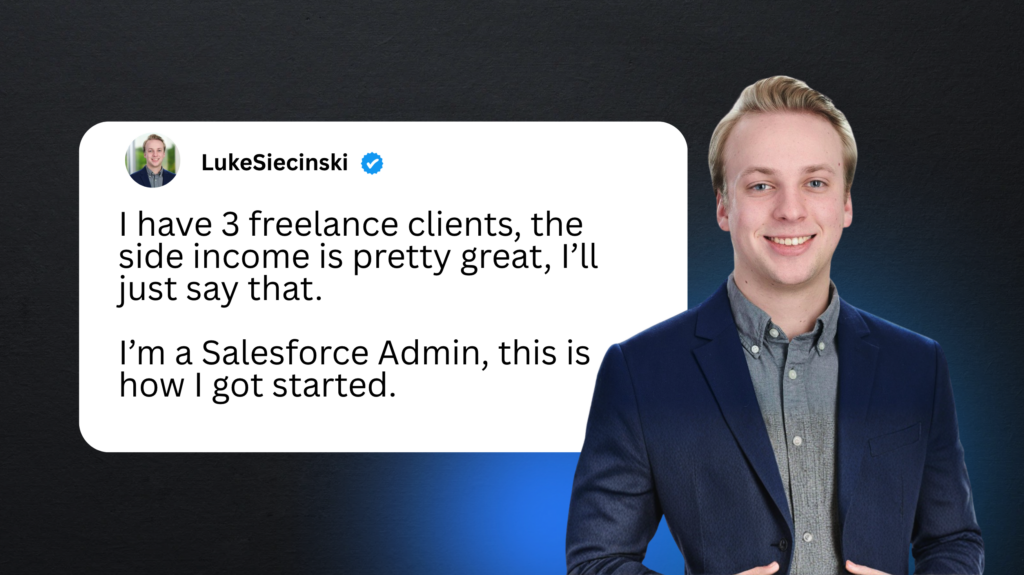
Getting started with Salesforce freelancing can feel intimidating, especially if you see yourself as “just an Admin”, “just a Business Analyst” or just an anything… or if you believe you need a highly specialized niche before clients will take you seriously. I recently had the chance to sit down with Luke Siecinski, a Salesforce Administrator, who shared how he moved from a traditional W2 role into successful freelance consulting without quitting his job, without chasing a flashy niche, and without overwhelming strategies.
His journey offers practical, grounded advice for Salesforce professionals who want to explore freelancing, solopreneurship, independent consulting (or whatever the kids are calling it these days).
Watch the video below for Luke’s full interview and a short quiz 🎉 in the video to learn as you watch.
What Starting a Salesforce Freelance Career is Actually Like
A Salesforce freelance focus rarely starts as a clean break from a full-time job. In most cases, it starts as a low-risk extension of the work you already know how to do. Freelancing doesn’t require an overnight identity shift.That distinction matters far more than whether you’re technically “full-time freelance” yet.
This hybrid approach is often the most realistic and sustainable way to start. Keeping a full-time role while freelancing allows you to test client work, learn how to scope projects, and understand what it means to deliver value independently, without tying your financial stability to your first few clients. For many Salesforce professionals, this phase isn’t a compromise. It’s a training ground. You learn how consulting feels before you decide whether you actually want it.
Luke’s freelance journey didn’t start with a dramatic leap. Instead, he built his consulting work alongside a full-time W2 role, something many aspiring freelancers don’t realize is a possible starting point.
“I’m freelancing on the side as an independent consultant… it’s on the side of my full-time W2 position.”
At the time of the interview, Luke was juggling three clients, one direct client and two subcontracting relationships, while still working a traditional Salesforce job. This hybrid model allowed him to gain experience, income, and confidence without the pressure of going all-in too early.
One direct client involved helping a real estate developer migrate from spreadsheets to Salesforce:
“Basically I’m helping him go from spreadsheets to Salesforce. He wanted a consolidated approach to his business.”
This kind of work highlights a recurring theme in Salesforce freelancing: many small and mid-sized businesses don’t need cutting-edge customization. They need someone who can translate business problems into practical Salesforce solutions.
The bigger lesson here isn’t how many clients Luke had or how fast he grew. It’s that Salesforce freelancing often starts by solving unsexy but meaningful problems for real businesses. That kind of work builds confidence, credibility, and momentum far faster than waiting for the perfect niche or the perfect moment.
You Don’t Need a Perfect Niche to Start Freelancing
“Niching down” is often treated like a prerequisite for freelancing, but in practice, it’s usually an outcome, not a starting requirement. Most Salesforce freelancers don’t choose a niche first and then find clients. They take on real work, notice patterns in the problems they solve, and discover their niche through experience.
Waiting to feel perfectly specialized before you start is one of the easiest ways to delay starting at all. Here’s what Luke had to say on the topic.
“At the beginning, that was my thought process a hundred percent. I’m not niched down. I felt that I was sort of a wear-many-hats person… good at Salesforce overall, not particularly amazing at any particular niche. That is just, honestly, it’s kind of a lie that I was telling myself.”
Many businesses simply need help with Sales Cloud, Service Cloud, and core Salesforce functionality, combined with someone who can understand people and processes. What Luke describes here is a common internal narrative among capable Salesforce professionals. Being “good at Salesforce overall” can feel like a weakness when compared to job descriptions that demand hyper-specific expertise. In reality, that versatility is often what makes someone effective as an independent consultant.
If you’re early in your freelance journey, your job isn’t to pick the perfect niche. Your job is to become reliably useful. Niche clarity tends to emerge after you’ve solved enough real problems to see where your strengths consistently show up.
Why “End-to-End” Salesforce Skills Matter More Than Titles
One of the biggest adjustments people underestimate when moving into freelancing is how blurry the lines between roles become. Job titles matter far less outside of a corporate environment. What matters is whether someone can identify a problem, guide a decision, and help a team move forward.
Freelancing compresses roles that are usually separated across departments into a single relationship. That shift can feel uncomfortable at first, but it’s also where much of the value comes from.
Luke and Bradley both emphasized the value of being “end to end”:
“It doesn’t mean you can do all of it great… but if you can do everything at 70% effectiveness, that’s usually good enough.”
In practice, Salesforce freelancers often act as:
- Business analysts gathering requirements
- Project managers coordinating timelines
- Admins configuring solutions
- Testers validating changes
- Trainers helping users adopt Salesforce
As Bradley put it:
“You might call me an admin, but I’m a business analyst all day long… and suddenly you become a PM… and now you’re a trainer.”
Being “end to end” doesn’t mean being an expert at every function. It means being capable of seeing a problem through from initial conversation to final adoption. That includes asking clarifying questions, making reasonable tradeoffs, and helping users actually use what you build.
Most clients don’t need perfection. They need confident progress.
The goal isn’t to master every role. It’s to be comfortable wearing multiple hats long enough to get something useful across the finish line. For Salesforce freelancers, breadth creates trust, and trust is what leads to repeat work, referrals, and long-term success.
How Salesforce Freelancers Actually Get Their First Clients
When people think about finding freelance clients, they often default to platforms like Fiverr or UpWork which lead to the lowest rates and smallest projects. They might also try a post or two on LinkedIn, or buying a domain and creating a website. While those approaches can work over time, they’re not the most effective or scalable way to land your first clients.
Early-stage freelancing is about momentum, not scale. You’re not building a lead engine yet you’re proving to yourself that people will pay for your help.
“I’ve had the most success with personal relationships. That’s where I’ve gotten most of my clients. I literally circled back through my network of folks that I’ve worked with before and said, ‘Hey, I’m doing this now.’”
This approach is often overlooked in favor of social media or content creation, but it’s usually the fastest and warmest path to early traction.
“You’re not looking to grow an enterprise consultancy. You need a handful of clients. This requires less effort than most realize”
If you’re wondering where to start, start with people who already trust you. Reach out, reconnect, and let them know how you can help now. For most Salesforce freelancers, the first win doesn’t come from being discovered… it comes from being remembered. You can absolutely expand into LInkedIn posting, lead magnets, email funnels and more, but start at the beginning.
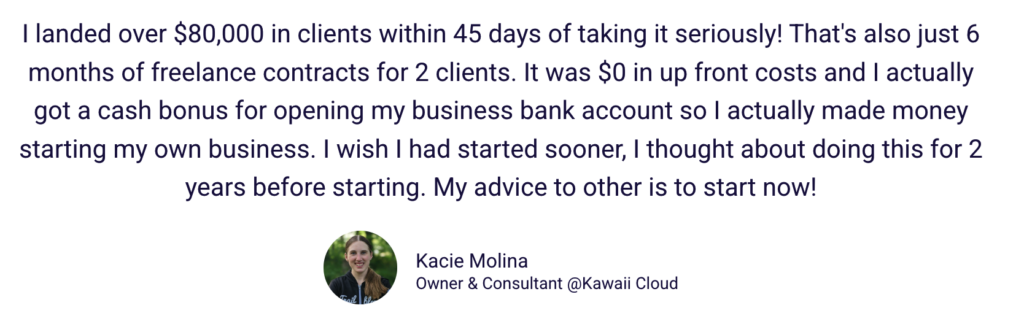
(The image below is from another Salesforce Freelancer, Kacie Molina, who got off to a really impressive start)
Final Thoughts: You’re Probably More Than “Just an Admin”
One of the most common patterns I see among Salesforce professionals considering freelancing isn’t a lack of skill. It’s a lack of permission they’ve given themselves to take the next step.
That’s why the phrase “just an Admin” or “just a Business Analyst” is so damaging. Most Salesforce Admins aren’t simply configuring fields or managing users. They’re gathering requirements, translating business needs, designing solutions, testing changes, training users, and supporting adoption. That’s consultant work, whether the title reflects it or not.
As Luke put it, “I doubt you’re just an admin.”
The gap between an admin and a consultant is often smaller than it feels. In many cases, the work is already there what’s missing is the confidence to own it and the context to apply it independently.
Salesforce freelancing isn’t about being flawless, deeply niched, or fearless. It’s about being useful, dependable, and willing to learn in public. It’s about starting where you are, leveraging the skills you already use every day, and building trust through real relationships.
If there’s one thing to take away from this conversation, it’s this: freelancing isn’t reserved for a future version of you. For many Salesforce professionals, it’s simply the next logical step and far more attainable than it first appears.
Want More Salesforce Career Content?
Watch Salesforce Career focused videos, listen to podcasts and check the menu items above for links to free content and courses.