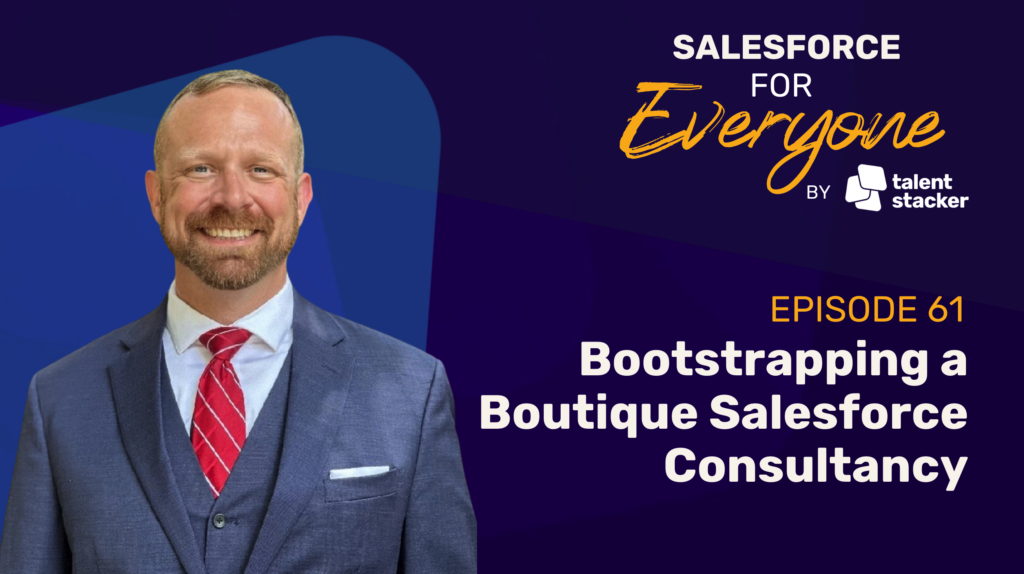
Joshua Karrasch didn’t build Dynamic Specialties Group overnight, and he didn’t build it perfectly. He built it through bankruptcy, burnout, failed hires, and a lot of hard-won clarity about what actually matters in business. In this episode of the Salesforce for Everyone podcast, Josh shares the philosophy, the mistakes, and the practical strategies behind one of the more quietly impressive boutique Salesforce consultancies in the ecosystem.
Who benefits from this article? Salesforce professionals, aspiring consultants, and small business owners who are building or thinking about building a consultancy of their own.
What can you expect as an outcome? You’ll walk away with a clear vision of a consultancy that delivers quality work, treats people well, and grows sustainably without burning out the people inside it.
Key Topics from Episode 61
1. The Accidental Admin Origin Story
Timestamp: 00:01:57 to 00:02:51
Like many in the Salesforce ecosystem, Josh didn’t plan his way in. He was sitting on the bench at a federal consulting firm when someone asked if he knew Salesforce. He didn’t. They told him to learn it. A few years later, that moment became the foundation for DSG.
2. From Bankruptcy to Business Builder
Timestamp: 00:02:51 to 00:05:26
Before DSG, Josh ran a retail firearms business that went bankrupt. He lost everything and moved into a friend’s basement. A call with entrepreneur Scott Duffy gave him the reframe he needed: a lion needs legs to hunt, and for an entrepreneur, that means capital. Josh spent two years rebuilding his finances before launching DSG, and this time, he was ready.
3. The Win-Win-Win Philosophy
Timestamp: 00:05:26 to 00:12:43
DSG operates on a three-part principle:
- The client has to win.
- The consultant doing the work has to win.
- The company facilitating it has to make a fair profit and that’s a win.
If any one of those three breaks down, the engagement isn’t worth taking. This isn’t just a tagline. It shapes every hiring decision, every client conversation, and every contract DSG signs.
4. The Accordion Model for Staffing
Timestamp: 00:15:41 to 00:21:54
After burning out two full-time W-2 hires by overloading them with work to cover overhead, Josh discovered the accordion model, a flexible 1099 contractor structure that expands and contracts with the natural rhythm of project-based consulting work. This model gave DSG the ability to take on work when it was there and scale back when it wasn’t, without destroying the people in the process. He’s able to facilitate this hiring model more readily by working alongside Talent Stacker Staffing.
5. The Mentor Who Changed Everything
Timestamp: 00:27:44 to 00:36:07
Josh credits one relationship as the single most important pivot in his entrepreneurial career: a mentor who walked into his previous business one cold January day and has been a weekly presence ever since. The mentor’s value wasn’t just advice; it was perspective. While Josh was buried in the day-to-day, his mentor could see what was coming down the road. Josh references this as “The Watcher” concept from the book The Way and the Power, someone above the noise who helps you navigate it.

6. Business Process Before Technology
Timestamp: 00:36:07 to 00:45:57
DSG’s most consistent source of value is leading every engagement with business process discovery before a single Salesforce solution is discussed. As Josh puts it, you can’t automate a process that isn’t defined. Many clients arrive having already:
- Purchased Salesforce licenses
- Worked with two or three previous partners
- Still achieved no successful outcome
DSG comes in, asks to see the documented process, and usually finds that’s exactly where the breakdown lives.
7. Hiring for Transferable Skills
Timestamp: 00:53:52 to 00:58:20
DSG doesn’t hire for tech pedigree. Josh actively looks for people with diverse, non-traditional backgrounds, including:
- Former handymen and carpenters
- Physical therapists
- Door-to-door salespeople
- Exotic animal trainers
The skills that make someone great at those jobs, including troubleshooting under pressure, empathy, project management, and persistence, are exactly the skills that make a great Salesforce consultant. Certifications can be earned. Character can’t be taught.actly the skills that make a great Salesforce consultant. Certifications can be earned. Character can’t be taught.
Notable Insights
“Growth is a cash-hungry beast.” Josh learned this the hard way when his first business grew too fast, lost its primary revenue source after a political administration change, and collapsed under the weight of its own overhead. At DSG, growth is intentional and controlled. In 2025, DSG hit approximately 28% growth, and even that broke their internal systems in the final quarter, forcing a full operational restructure. More growth isn’t always better growth.
Profits matter, but they can’t be your only guiding light. Josh is clear-eyed about financials: a business that doesn’t profit can’t survive, and ignoring your numbers is not a virtue. But making profit the sole measure of success leads to exploitation of clients, employees, and partners. When you orient the business around people winning, the profits tend to follow.
Boutique isn’t about size; it’s about quality. Josh draws a vivid analogy: when you walk into a bespoke tailor, you’re paying for someone who fits a suit to exactly who you are, your posture, your skin tone, the way you move. That’s what boutique consulting should feel like. DSG is deliberate about not growing beyond the point where they can still deliver that level of personalized, empathetic, high-quality work.
You can’t truly understand something until you’ve felt it. Direct experience teaches in ways no book, podcast, or thought exercise can replicate. Josh uses the hot stove analogy: your parents can tell you not to touch it, but the moment you do, it’s burned into your subconscious permanently. The same is true for every hard business lesson:
- The slow November you didn’t see coming
- The quarter where you hired too fast
- The client you should have said no to
You learn it when you live it.
A-players can be found, if you look in the right places. DSG noticed something consistent: candidates who came through Talent Stacker’s 3–6 month program almost always showed up as A-players. The reason, Josh concluded, is that Bradley and his team had already observed those candidates over an extended period, seeing how they handle pressure, setbacks, and sustained effort. That’s information a one-hour interview will never give you.
Want Even More Salesforce Career Content?
Watch Salesforce Career focused videos, listen to podcasts and check the menu items above for links to free content and courses.