There is a big difference between reading about Agentforce and actually shipping it in a live production environment.
I know this because I have done both. Over the past year I built and deployed a full suite of Agentforce use cases inside a real enterprise org, with real users, real customer data, and real business pressure to deliver results. Not a sandbox. Not a proof of concept. Production.
What I learned along the way is not in the documentation. This article is that gap.
What the Client Actually Wanted
The goal was straightforward: close cases faster.
The service team was spending too much time on manual work. Reading emails, figuring out where to route cases, deciding which team should handle what. Agentforce seemed like the obvious answer.
And it was. But not in the way anyone expected.
Expectation vs Reality: The Human in the Loop
The first thing that changed was the automation model.
The original idea was to let Agentforce route cases automatically. A case comes in, AI reads it, AI routes it. Done. Faster, no human needed.
The reality: the client was not ready for that. And honestly, they were right not to be.
Case routing is not just a technical decision. It involves business rules, team capacity, customer relationships, and accountability. Handing that fully to an AI without a review step made the team uncomfortable, and it created real risk if the AI got it wrong.
So we adapted. Instead of automated routing, we used Agentforce to generate routing recommendations through prompt templates and Einstein Next Best Action. A human still made the final call. The AI just did the analysis and surfaced the suggestion.
The result was still a big win. Agents stopped spending 10 minutes trying to figure out where a case should go. They spent 10 seconds reviewing a recommendation and clicking confirm.
The lesson: AI does not have to be fully autonomous to deliver value. Sometimes the right design is AI plus a human, not AI instead of a human.
The Technical Friction Nobody Warned Me About
Token limits are real
When you are running prompt templates at scale, token limits become a real constraint very quickly. Long email threads, complex case histories, detailed product descriptions all eat through tokens fast.
You need to think carefully about what you feed into each prompt. More context is not always better. Sometimes a focused, trimmed input gives you a better output than a full data dump.
Credits add up
Agentforce runs on Einstein credits, and in a high volume service environment those credits go fast. This is not a reason to avoid Agentforce. But it is something you need to plan for before you go live, not after.
Build a rough estimate of your monthly volume and what that translates to in credit consumption. Have that conversation with your client early.
Einstein Next Best Action and Agentforce are not plug and play
This one caught me off guard. Einstein NBA and Agentforce can absolutely work together, but the integration is not as seamless as the marketing material suggests.
Getting NBA recommendations to surface correctly inside an Agentforce flow requires careful setup, and some of the expected connections between the two features are more manual than they should be. Expect to spend time here.

The Business Logic Problem
Here is something nobody talks about: AI is only as good as the process it is automating.
When we started mapping out the routing logic, we discovered that the client’s existing business rules were inconsistent and in some cases broken. Teams had informal agreements that were never documented. Some cases were being routed based on habits, not actual criteria.
Agentforce forced a conversation that the business needed to have anyway. You cannot automate a process that does not exist in a clear form.
Before you build, make sure you understand the actual current state of the process. Not the ideal version. Not the version on the PowerPoint slide. The real one.
Getting Users to Actually Use It
The technology worked. Getting people to trust it was a different challenge.
Service agents are experienced professionals. They have their own ways of doing things and they are rightly skeptical of tools that promise to make their job easier but add more steps in practice.
What worked was not pushing the tool. It was showing people what it did for them specifically. We ran hands on workshops where agents could see the AI summarize a real case, see the routing recommendation, and ask questions about how it worked.
Once agents saw that the AI was doing the boring part and leaving the judgment to them, the resistance dropped. They were not losing control. They were getting their time back.
What to Take Away From This
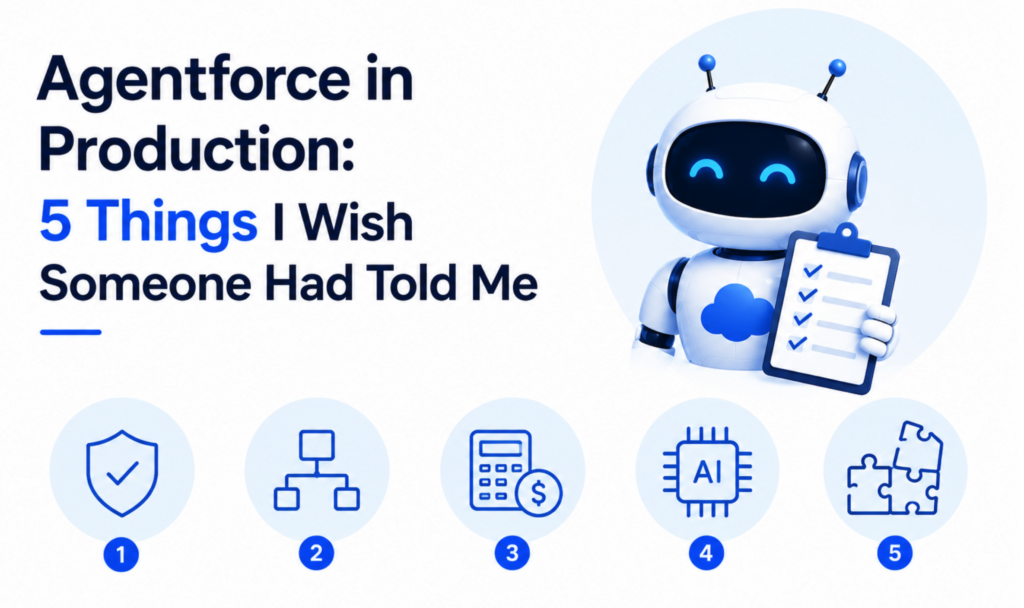
If you are about to build Agentforce for a client, here are the things I wish someone had told me:
Design for trust, not full automation. A human in the loop is not a failure. It is often the right architecture, especially early on.
Clean up the process before you automate it. Broken logic becomes broken AI. Fix the business rules first.
Plan your credit consumption before you go live. Volume estimates are not optional.
Watch your token budgets. Less input, better focused, usually beats more input.
Expect integration gaps. Features that sound connected in the documentation may need manual work to actually connect.
Invest in user education. A workshop is not overhead. It is part of the delivery.
Agentforce is a powerful tool. But like any tool, the result depends on how you use it. The teams that go in with realistic expectations and a solid deployment plan are the ones that get the ROI.
Want Even More Salesforce Career Content?
Watch Salesforce Career focused videos, listen to podcasts and check the menu items above for links to free content and courses.
About the Author
Luca Pero is a Salesforce professional driven by curiosity, someone who likes to understand how things work. That mindset, combined with his deep interest in AI, led him to help companies implement Agentforce.
Luca recently founded a boutique consultancy that helps companies implement Agentforce (https://sfaiforce.com/). If anyone in the community is exploring Agentforce or knows a company that needs help implementing it, connect with Luca on LinkedIn here.