I used to think you needed Data Cloud to do anything real with Agentforce.
I was wrong. And if you have been holding off on Agentforce because you assumed the same thing, this article is for you.
Where This Assumption Comes From
It is an easy mistake to make. Salesforce talks about Data Cloud constantly in the context of AI. The demos often show it. The marketing material leans on it. If you put Agentforce and Data Cloud side by side enough times, your brain starts to treat them as a package deal.
So when I started planning my first real Agentforce implementation, I assumed Data Cloud was step one. It is not.
What I Actually Built
Over the past year I have deployed twelve different Agentforce use cases in a real production environment. Case summaries, case triage, routing recommendations, account summaries, opportunity summaries, email generation, and more, across both Service and Sales.
Every single one of them ran without Data Cloud.
Not most. Not the simple ones. All twelve.
Why This Works
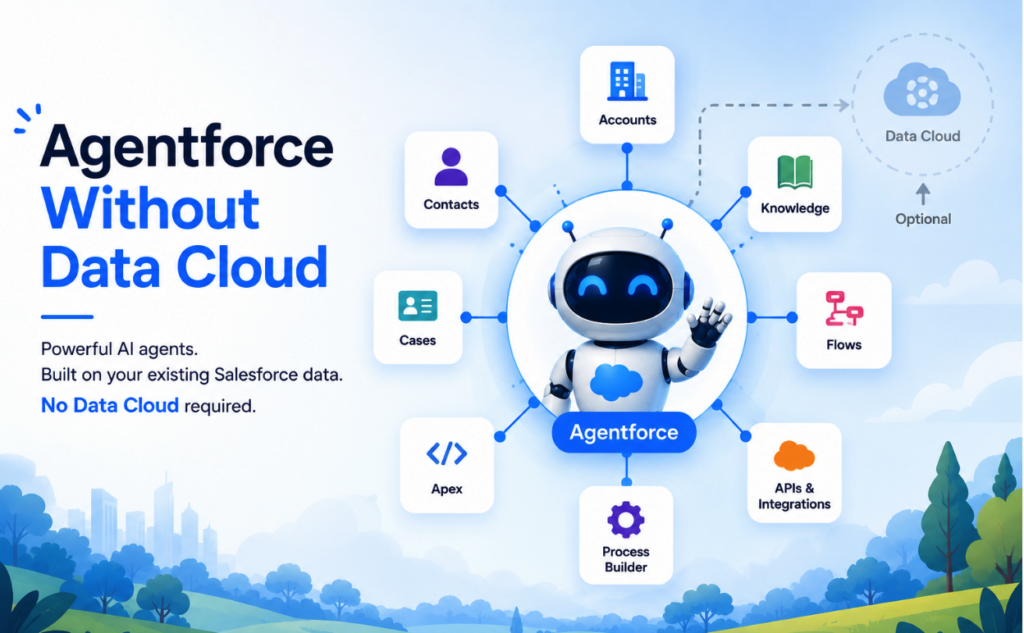
Agentforce is built to work with the data already inside your Salesforce org. Cases, accounts, opportunities, emails, custom objects, all of it is accessible to Agentforce through standard configuration.
There is no hard requirement linking Agentforce agents to Data Cloud. You can build and run agents without it. What you will miss is the out of the box dashboards and reports for generative AI data, since that reporting layer relies on Data 360, which is part of Data Cloud. When Agentforce is active, it automatically collects and processes interaction data through Data Cloud in the background, but that is separate from whether your agents can actually run and deliver value.
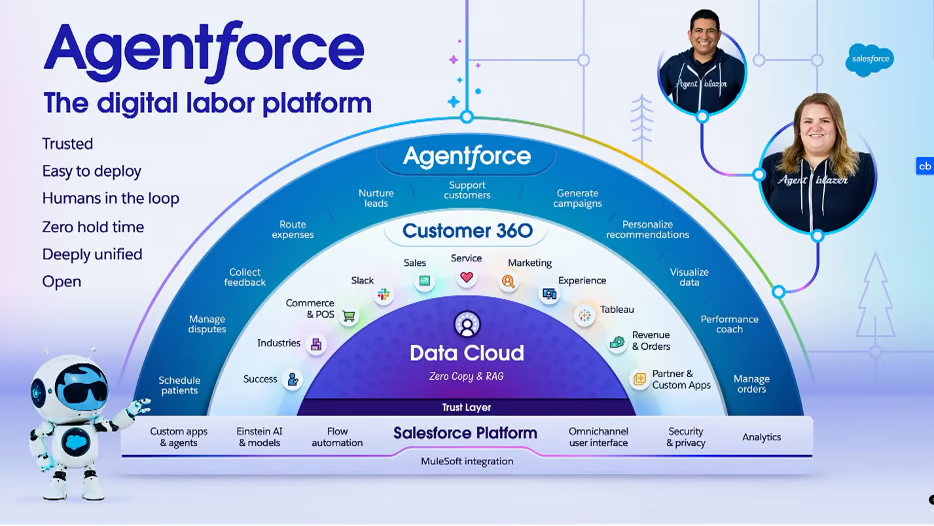
It helps to think about Agentforce as one piece of a bigger picture, made up of three layers. Agentforce itself is the semantic layer, the part that interprets requests and generates responses. Then there is the data stack, which includes your Salesforce CRM data, Data Cloud if you have it, and potentially other platforms like Snowflake, Databricks, or SAP. And there is the integration layer, which handles real time calls to information that lives outside your immediate data sources.
These three layers are interdependent. A decision you make about your data stack will affect what your semantic layer can do, and vice versa. But none of that changes the core point: if your data already lives in Salesforce in a reasonably structured way, the semantic layer can do real work with what you already have.
Data Cloud becomes valuable when you need to unify data from multiple systems outside Salesforce, when you are dealing with massive volumes of unstructured data that need to be harmonized before AI can use them well, or when you want the built in reporting on your AI usage. That is real and important, but it is not a requirement to get started building with agents.
If your data already lives in Salesforce in a reasonably structured way, you can build powerful Agentforce use cases right now, with what you already have.
What You Actually Need Instead
Here is what made the difference in practice, more than any platform add-on:
Clean object relationships. Agentforce needs to understand how your records connect. Accounts to cases, cases to products, opportunities to contacts. If your data model is solid, Agentforce can work with it.
Clear business logic. As I covered in my last article, AI can only automate a process that is actually well defined. This matters more than any extra tool you might add.
Well configured prompt templates. This is where a lot of the real work happens. A good prompt template, built around your actual data and use case, will outperform a more expensive setup with a vague one.
Permission and access setup done right. Agentforce needs the right access to the right objects. This sounds basic, but it is one of the most common points of friction in early deployments.
None of this requires Data Cloud. All of it requires a clear understanding of your org and your use case.
When You Might Actually Need Data Cloud
To be fair, there are real scenarios where Data Cloud adds value:
- You want the out of the box dashboards and reports on your generative AI usage and performance, since that reporting depends on Data 360
- You have customer data scattered across multiple systems outside Salesforce that you need unified in one place
- You are working with very high volumes of unstructured data that need processing before AI can use it effectively
- You want a single customer profile that blends Salesforce data with external sources like a data warehouse or a marketing platform
If any of those apply to you, Data Cloud is worth exploring. But that is a decision to make based on your actual data architecture and reporting needs, not an assumption you make before you have even scoped the project.
The Real Takeaway
Do not let the assumption that you need more tools stop you from starting.
If your Salesforce data is reasonably clean and your business logic is clear, you can build meaningful, high impact Agentforce use cases today, with the platform you already have.
Start there. Add Data Cloud later if and when your actual data architecture calls for it.
Want Even More Salesforce Career Content?
Watch Salesforce Career focused videos, listen to podcasts and check the menu items above for links to free content and courses.
About the Author
Luca Pero is a Salesforce professional driven by curiosity, someone who likes to understand how things work. That mindset, combined with his deep interest in AI, led him to help companies implement Agentforce.
Luca recently founded a boutique consultancy that helps companies implement Agentforce (https://sfaiforce.com/). If anyone in the community is exploring Agentforce or knows a company that needs help implementing it, connect with Luca on LinkedIn here.