If you’ve been in the Salesforce ecosystem lately, you’ve heard the word Agentforce everywhere. On LinkedIn, at events, in release notes. And if you’re like most people, you’ve nodded along while quietly wondering: what actually is this thing?
This article is for you. Just a clear explanation of what Agentforce is, what it does, and most importantly, what it means for your career and your clients.
Let’s Start With the Problem It Solves
Think about how a Salesforce user spends their day.
A service agent opens a case, reads through a long email thread, tries to understand what the customer wants, looks up the account/email history, figures out what’s going on, and then types a response. That process might take 10 minutes. Multiply that by 50 cases a day, and you’re looking at a significant chunk of time spent on work that is repetitive, manual, and honestly, not the part of the job anyone finds meaningful.
Or think about a sales rep. Before every call, they need to review the account, the open opportunities, the last interaction notes. Most of the time, they don’t. Not because they don’t want to, but because there’s no time.
This is the problem Agentforce is built to solve.
So What Is Agentforce, Exactly?
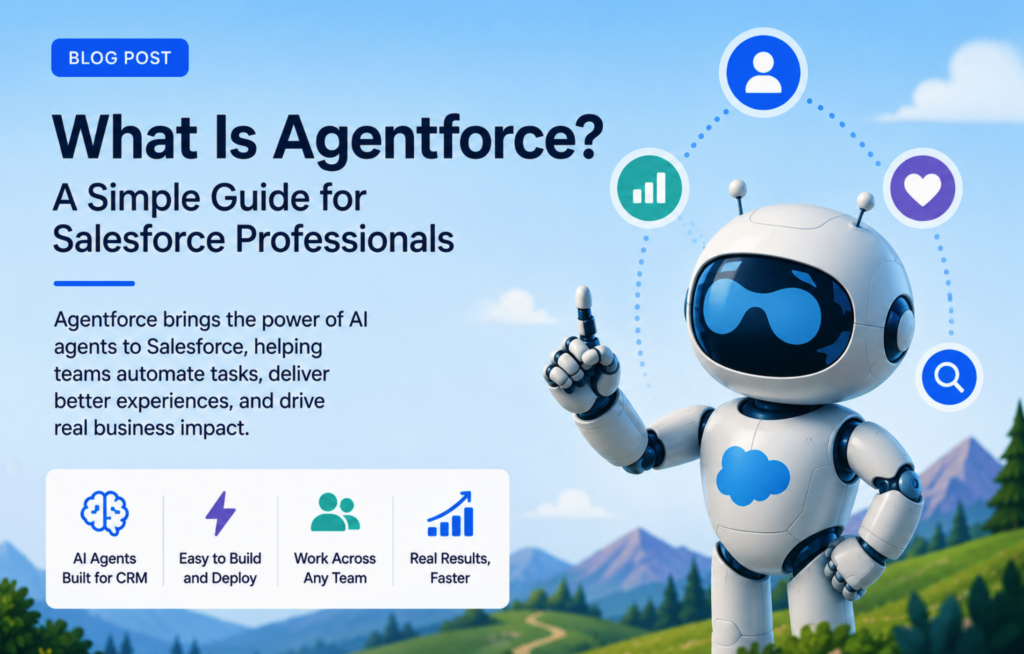
Agentforce is Salesforce’s AI layer built natively inside the platform, that can read, reason, and act on your Salesforce data automatically.
Think of it as a tireless digital teammate. It sits inside your org, watches what’s happening, and handles the repetitive cognitive work so your people can focus on what actually requires a human.
It’s not a chatbot. It’s not just a copilot that suggests things. Agentforce can actually do things: summarize records, route cases, generate responses, answer questions, and take actions. All within your existing Salesforce environment.
And unlike some AI tools you may have seen, it doesn’t need to go outside your system. It works with the data you already have in Salesforce.
What Can It Actually Do?
Here are real examples, the kind that are already running in production environments today:
For Service Teams:
- Reads an incoming case email and generates a summary before the agent even opens it
- Automatically routes a case to the right team based on topic, urgency, and customer tier
- Suggests the right product or resolution based on the case context
- Generates a draft response for the agent to review and send
For Sales Teams:
- Summarizes an account before a call. Recent activity, open opportunities, key contacts
- Drafts a follow-up email based on the opportunity details
- Flags which opportunities need attention this week
The common thread: Agentforce handles the prep work and the repetitive decisions, so your team can focus on the conversation.
What It Is NOT
Let’s clear up a few things, because there’s a lot of noise out there.
Agentforce is not a replacement for your team. It’s a force multiplier. The service agent still reviews, approves, and sends. The sales rep still makes the call. Agentforce handles the groundwork.
Agentforce is not science fiction. These aren’t demo features or beta experiments. Companies are running this in production right now, on live customer data, at scale.
Agentforce is not only for enterprise. You don’t need a massive org or a Data Cloud contract to get started. Many use cases run on standard Salesforce data and a few configuration steps.
Agentforce is not a one-size-fits-all product. It’s a framework. You decide which use cases to activate, in what order, and how much autonomy the AI gets.
Why This Matters for Your Career
Here’s the part I want you to really sit with.
Every Salesforce professional who understood Flow before their peers had an advantage. Every consultant who learned Lightning before their clients asked for it had an advantage. Agentforce is that moment, except bigger.
The professionals who understand how to configure, deploy, and explain Agentforce to stakeholders are already separating themselves from the pack. Not because they have a certification, but because they can do the thing.
The companies that adopt Agentforce are going to have a competitive edge over those that don’t. That means clients will be looking for people who can help them get there. That’s the opportunity.
Not using Agentforce right now isn’t neutral. It’s falling behind.
How Do You Get Started?
The good news: you don’t need to learn a new programming language. If you’re already a Salesforce Admin or Consultant, most of what you need is already in your toolkit.
A few starting points:
- Trailhead has Agentforce-specific modules, start with the Agentforce basics trail
- Salesforce’s official documentation covers each feature in detail
- The Trailblazer Community has active threads from people already building
And if you want to see what a real implementation looks like, the use cases, the configuration decisions, the gotchas, that’s exactly what I’ll be covering in the next articles in this series.
The Bottom Line
Agentforce is not the future of Salesforce. It’s the present.
It’s a native AI layer that handles the repetitive cognitive work inside your org, summarizing, routing, drafting, and acting, so your team can focus on what actually requires a human.
The professionals who understand it now are the ones clients will be calling in six months.
Want Even More Salesforce Career Content?
Watch Salesforce Career focused videos, listen to podcasts and check the menu items above for links to free content and courses.
About the Author
Luca Pero is a Salesforce professional driven by curiosity, someone who likes to understand how things work. That mindset, combined with his deep interest in AI, led him to help companies implement Agentforce.
Luca recently founded a boutique consultancy that helps companies implement Agentforce (https://sfaiforce.com/). If anyone in the community is exploring Agentforce or knows a company that needs help implementing it, connect with Luca on LinkedIn here.