Everyone talks about AI saving time. Very few people show you exactly where that time goes.
I have spent the last year building and shipping Agentforce in a real production environment. Service Cloud, live users, real cases. And across all the use cases we deployed, five stood out as the ones that delivered visible, measurable results from day one.
This is not a feature list. This is what actually moved the needle.
Why Service Cloud First
If you are trying to figure out where to start with Agentforce, Service Cloud is the answer.
The math is straightforward. A service team handles dozens of cases per day per agent. Each case involves repetitive cognitive work: reading, summarizing, categorizing, routing, responding. That work happens hundreds or thousands of times a day, every day.
Even small time savings per case add up fast. Salesforce’s own ROI framework uses 200 service employees handling 20 conversations per day as a baseline. At that volume, saving 10 minutes per case across even 20% of interactions translates to millions of dollars in recovered capacity over three years.
That is the opportunity. Here is how you capture it.
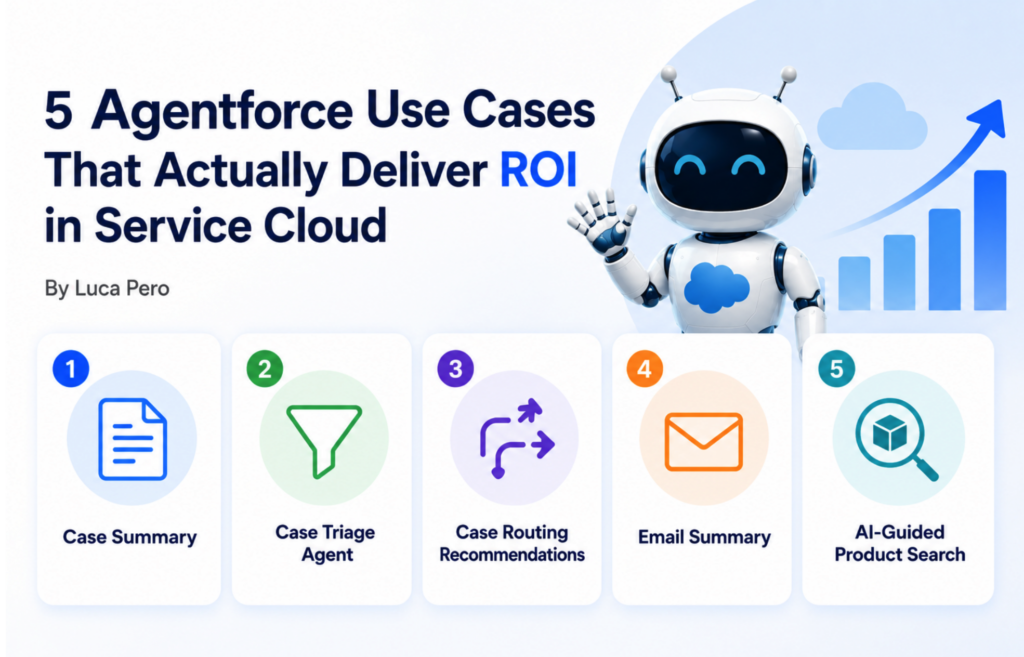
Use Case 1: Case Summary
What it does: When an agent opens a case, Agentforce has already read the full email thread and generated a plain summary of what the customer wants, what has been tried, and what the current status is.
Why it matters: Agents were spending the first several minutes of every case just getting up to speed. With a summary already there, they skip straight to solving the problem.
The impact: 10 minutes saved per case, on every case, every day. In a high volume environment that is hours of recovered capacity per agent per week.
This is one of the easiest use cases to deploy and one of the fastest to show results. It is usually the first one I recommend.
Use Case 2: Case Triage Agent
What it does: Agentforce reads the case as it comes in and categorizes it automatically. Product issue, billing question, technical support, complaint. Whatever your categories are, the AI assigns them before a human touches the case.
Why it matters: Triage sounds simple but it is often where cases get stuck. Miscategorized cases get routed to the wrong team, sit in the wrong queue, and create delays that frustrate customers and agents alike.
The impact: Faster first response, fewer misrouted cases, and agents who spend their time solving problems instead of sorting them.
Use Case 3: Case Routing Recommendations
What it does: Instead of automating routing completely, Agentforce generates a routing recommendation using prompt templates and Einstein Next Best Action. The agent sees the suggestion and confirms with one click.
Why it matters: Full automation of routing is often not the right first step. Business logic is complex, teams have nuances, and there is real accountability when a case goes to the wrong place. A recommendation model gives you most of the speed benefit while keeping a human in the loop.
The impact: Agents stop spending time deciding where to send a case. They spend seconds confirming a recommendation instead. The quality of routing also improves because the AI is applying consistent logic every time, not relying on whoever happens to be triaging that morning.
This is also a great starting point for clients who are not ready to trust full AI automation. It builds confidence in the system before you push toward more autonomous flows.
Use Case 4: Email Summary
What it does: Similar to case summary, but focused specifically on long customer email threads. Agentforce reads the full thread and produces a short summary of the key points.
Why it matters: Long email threads are one of the most common sources of wasted time in service teams. Agents scroll through pages of back and forth trying to find the core issue. This use case eliminates that entirely.
The impact: Time savings are immediate and visible. Agents notice this one from the first day.
Use Case 5: AI-Guided Product Search
What it does: When a customer describes a problem or a need, Agentforce can surface relevant products or solutions based on the case context, without the agent having to search manually.
Why it matters: In B2B service environments especially, agents are often juggling large product catalogs. Finding the right match quickly requires product knowledge and search time that not every agent has. Agentforce closes that gap.
The impact: Faster resolution, more consistent product recommendations, and agents who feel supported rather than overwhelmed.

The Pattern Across All Five
Looking at these use cases together, the common thread is clear.
Agentforce is not replacing the agent. It is handling the prep work. The reading, the categorizing, the searching, the recommending. Everything that happens before the actual human judgment call.
That is where the time goes in a service team. And that is where Agentforce earns its ROI.
Where to Start
If you are building for a client or evaluating where to start in your own org, my recommendation is this order:
- Case Summary, because it is fast to deploy and the value is immediately visible to every agent
- Email Summary, because it solves the same problem in a slightly different context
- Case Triage, because it cleans up the front of the queue
- Case Routing Recommendations, because it requires understanding the client’s business logic first
- AI-Guided Product Search, because it depends on having clean product data to work with
You do not have to deploy all five at once. Even one of these, done well, will change how your team experiences Salesforce.
Want Even More Salesforce Career Content?
Watch Salesforce Career focused videos, listen to podcasts and check the menu items above for links to free content and courses.
About the Author
Luca Pero is a Salesforce professional driven by curiosity, someone who likes to understand how things work. That mindset, combined with his deep interest in AI, led him to help companies implement Agentforce.
Luca recently founded a boutique consultancy that helps companies implement Agentforce (https://sfaiforce.com/). If anyone in the community is exploring Agentforce or knows a company that needs help implementing it, connect with Luca on LinkedIn here.