If you’re looking to land your first Salesforce job, level up your current career or simply want direction, feedback and accountability mentorship is something that should be on your radar.
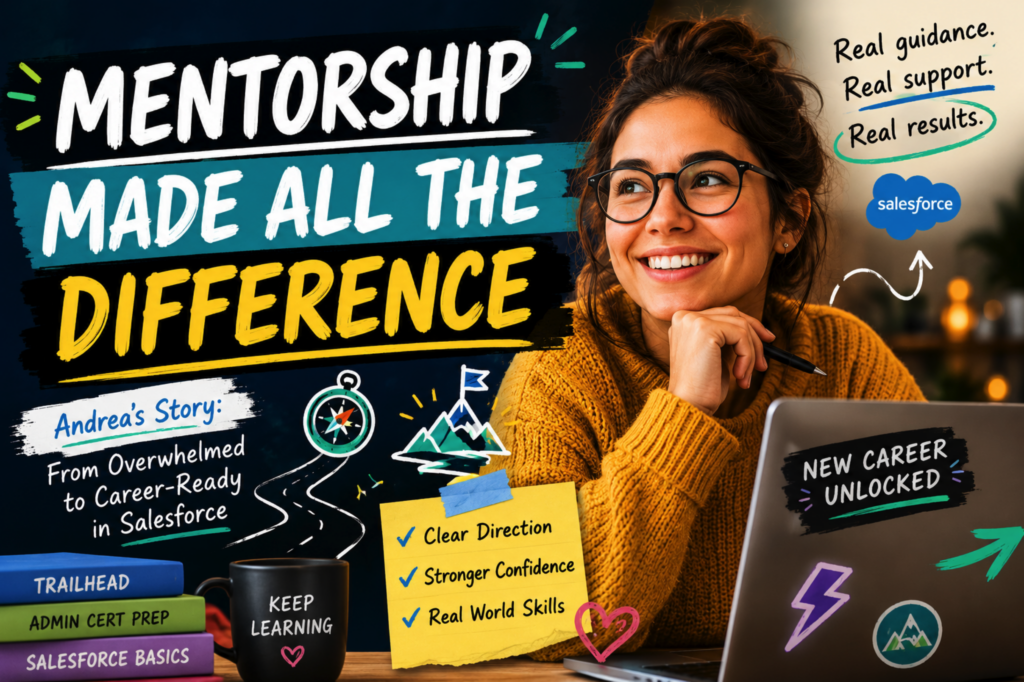
Andrea Garibotto is a recent Mentee on the Trailblazer Mentorship Platform and knows the value of a mentor well. Before having a mentor, she was studying toward her Salesforce Administrator certification, taking practice exams and looking to break into her first Salesforc role. We asked her to walk through what mentorship actually changed for her, in her own words. Here’s her story, quote by quote, along with what you can take from it.
What were you up to before having a mentor?
“Before joining the mentorship program, I was already studying Salesforce and working toward becoming a Salesforce Administrator. I had a background in Functional Analysis and QA, so I was comfortable with processes, testing, data, and understanding how systems work, but Salesforce was a new ecosystem for me. I had been learning mostly through Trailhead and independent study. The amount of information available is incredible, but that can also become overwhelming. I often found myself asking: What should I prioritize? Am I learning the right things? How do I connect all these Salesforce features to real business scenarios? And how do I translate my previous experience into a Salesforce career? I also wanted to move beyond simply learning how to configure Salesforce. I wanted to understand how to approach real-world problems and design solutions thoughtfully.”
What this means: Andrea wasn’t starting from zero. She had transferable skills and was putting in real study time. Her problem was a prioritization problem, not a knowledge problem. Trailhead gave her tons of content and textbook learning, however clear direction was lacking.
Key takeaway: Having “enough information” is not the same as knowing what matters. Overwhelm at this stage is usually a sign you need a filter, not more content.
Take action: Before you add another course or badge to your plate, write down the specific business scenarios you want to be able to handle in a real job. Then audit whether what you’re studying actually maps to those scenarios. If it doesn’t, that’s a strong signal you need outside perspective, not more Trailhead modules. Learn about what transferable skills you might have.
Why were you looking for a mentor?
“I realized that studying alone can teach you the platform, but it doesn’t necessarily teach you how an experienced professional thinks. I was looking for someone who could challenge my assumptions, help me see things from a different perspective, and give me guidance based on real experience. I also think that when you are changing careers, having someone who has already gone through part of that journey can save you a lot of time. Instead of constantly wondering whether I was going in the right direction, I could discuss my questions with someone who understood both Salesforce and the realities of working in the ecosystem. That was the main reason I decided to seek mentorship.”
What this means: Self-study can teach you what a field or buttons does. It can’t teach you professional judgment, and it can’t tell you whether you’re actually on the right track. That requires someone who’s already been where you’re trying to go.
Key takeaway: Time saved is one of the most underrated benefits of mentorship. A mentor doesn’t just add value, they remove the guesswork that eats up months of your career-change timeline.
Take action: If you’re spending more time wondering whether you’re on the right path than actually building skills, that’s your cue to find a mentor. Don’t wait for a “perfect” moment. Apply to the Trailblazer Mentorship Platform now, while you still have unanswered questions. That’s exactly when mentorship is most useful.

How did your mentor help to change your approach?
“My mentor, Supriya Jamboor Nagesh, helped me significantly in the way I approach problems. One of the most important lessons I learned was to avoid jumping immediately into a Salesforce feature or technical solution. First, understand the business problem, ask the right questions, identify the real requirement, and then decide what solution makes sense. That sounds simple, but it changed the way I think. Technically, our conversations helped me connect Salesforce concepts with real scenarios instead of treating them as isolated features. But the biggest impact was probably on my confidence and mindset. Having someone experienced review my thinking and encourage me to keep going helped me recognize that my previous experience in QA and Functional Analysis was not something I had to leave behind. It could actually become part of my value as a Salesforce professional. The mentorship also encouraged me to become more involved with the Salesforce community and to think about networking and professional visibility as part of my career development, not as something separate from learning.”
What this means: The highest-value lesson Andrea got wasn’t a technical trick. It was a discipline: problem first, solution second. That single habit is what separates someone who configures Salesforce from someone who solves business problems with it. Just as important, mentorship gave her permission to see her past career as an asset instead of largely unrelated.
Key takeaway: A good mentor doesn’t just transfer knowledge. They transfer a way of approaching problems, and they help you reframe your existing background as a strength.
Take action: In your next practice project or mock scenario, force yourself to write out the business problem and the actual requirement in plain language before you touch any Salesforce configuration. If you can’t articulate the problem without jargon, you’re not ready to build the solution yet. Also: list three skills from your previous career and write one sentence on how each one applies to Salesforce work. That’s the exercise Andrea’s mentor pushed her toward. Take a look at how Bethany Smith got hands-on experience prior to her first job.
What did you do differently after gaining mentorship?
“As a result of the mentorship, I became much more intentional about my learning path. I have continued studying for the Salesforce Administrator certification and working on practical Salesforce scenarios and projects. I have also been improving my English because I want to be able to work in international environments. Another important step has been becoming more active in the Salesforce community. I have participated in Salesforce-related projects and community activities, and I have started sharing more of my learning and experiences publicly. One of the biggest outcomes so far is that I have a much clearer idea of the kind of professional I want to become. I am not simply trying to ‘get into Salesforce.’ I want to combine Salesforce, QA, data, automation, and process improvement in a way that makes me useful when solving real problems. I am still in the process of building that career, so I would describe my results as progress rather than a finished success story. For me, that is also important to be honest about: mentorship doesn’t magically produce a job or certification. It gives you better direction, perspective, and tools, and then you have to do the work.”
What this means: Mentorship gave Andrea a target to aim at, not a finish line handed to her. Her actions since then, certification prep, practical projects, community involvement, public sharing, are the work she did because she had clearer direction. The mentorship itself didn’t do that work for her.
Key takeaway: Direction plus effort produces progress. Direction without effort produces nothing, and effort without direction produces exactly what Andrea described before mentorship: overwhelm.
Take action: After any mentorship conversation, convert what you discussed into two or three concrete next steps within 48 hours, whether that’s a project to build, a certification module to finish, or a community activity to join. Track your own progress honestly. You’re not looking for a finished success story either. You’re looking for forward motion.
Looking for motivation? Watch how this stay at home mom landed her first Salesforce job or how this Salesforce pro is freelancing with companies globally!
Where do you think you would be without a mentor now?
“I think I would still be learning Salesforce, but my journey would probably have been much more fragmented. I tend to be very curious, so without mentorship I could easily spend a lot of time learning many different things without knowing which ones were most important for my career. I also think I would have focused more heavily on the technical side and less on the reasoning behind a solution. The mentorship helped me understand that becoming a Salesforce professional isn’t just about knowing where to click. It’s about understanding people, processes, requirements, data, and the impact of the solution you are designing. That changed the direction of my learning.”
What this means: Curiosity without a filter can work against you. Andrea’s natural drive to learn everything would have kept her busy, but not necessarily employable. The mentor’s role wasn’t to slow her down, it was to point her curiosity at the right targets.
Key takeaway: Being a hard worker isn’t the same as being a strategic one. Without guidance, effort tends to spread evenly across everything instead of concentrating on what actually moves your career forward.
Take action: Ask yourself right now: am I learning broadly because it’s strategic, or because it feels productive? If you can’t clearly answer that, it’s worth getting a second set of eyes on your learning plan before you invest another few months in it.
What would you say to someone considering getting a mentor?
“I would tell them: Don’t wait until you feel ‘ready’ to ask for a mentor. You don’t need to have everything figured out before joining a mentorship program. In fact, I think mentorship is most valuable when you still have questions. Come prepared to learn, but also come prepared to be challenged. And don’t expect your mentor to give you a step-by-step map for your entire career. The best mentors don’t make decisions for you. They help you think better, ask better questions, and see possibilities you may not have considered. For me, the value was not only learning more about Salesforce. It was learning how to think about my career and my own capabilities differently.”
What this means: Waiting to feel “ready” is one of the most common reasons career changers stall out. Andrea’s point is direct: readiness isn’t a prerequisite for mentorship, it’s often the outcome of it.
Key takeaway: A mentor isn’t there to hand you a map. They’re there to sharpen your thinking so you can build your own map, and be challenged enough that it actually holds up.
Take action: If you’ve been telling yourself you’ll look for a mentor “once you know more” or “once you’re further along,” treat that as your sign to stop waiting. Sign up now, while you still have real questions to bring to the table.
Describe your journey in 3 words
“Curiosity. Persistence. Transformation. Curiosity, because I genuinely enjoy learning and asking questions. Persistence, because changing careers and building new skills isn’t always easy, and there are many moments when you have to keep going without immediate results. And transformation, because this experience has been about much more than learning a new technology. It has changed how I see my previous experience, my professional possibilities, and the kind of problems I want to solve.”
What this means: Notice that “certification” and “job title” aren’t in her three words. The transformation she’s describing is in her thinking and her sense of professional identity, not just her resume.
Key takeaway: The most durable outcome of mentorship isn’t a credential. It’s a shift in how you see your own value and potential.
Take action: Try Andrea’s exercise yourself. If you had to describe your own career-change journey in three words right now, what would they be? If none of them relate to confidence, direction, or identity, that may be exactly what’s missing from a self-guided path.
Are there any takeaways you feel others should know?
“One thing I would emphasize is that you don’t have to fit into a single professional box. I initially wondered whether my background in QA and Functional Analysis would make sense in a Salesforce career. Through mentorship, I started seeing those experiences differently. Testing, process analysis, data quality, understanding requirements, and questioning assumptions are all valuable when working with Salesforce. Sometimes the skills you already have are not obstacles to your new career. They are part of what can make you different.”
What this means: Andrea’s biggest fear going in, that her background didn’t belong in Salesforce, turned out to be false. Mentorship gave her the outside perspective to see her own experience clearly, something that’s genuinely hard to do on your own.
Key takeaway: Your past career is rarely a liability in a career change. It’s usually your differentiator, but you often need someone else to help you see it that way.
Take action: Write a short list of the skills from your previous career that felt “unrelated” to Salesforce. Bring that list into a mentorship conversation and ask directly: how could this be an asset instead of something I need to hide on my resume?
“One of the most valuable lessons from my mentor was to understand the business problem before designing the Salesforce solution. It sounds obvious, but it is easy to become focused on the technology and forget the people and processes behind it. That lesson has stayed with me because I think it applies far beyond Salesforce. Good technology solutions start with good questions.”
Start where Andrea started
Andrea is candid that mentorship didn’t hand her a job or a certification. What it gave her was direction, perspective, and the tools to do the work herself. If her story sounds like where you are right now, studying hard but unsure what to prioritize, wondering if your background even fits, that gap is exactly what a mentor closes.
The Trailblazer Mentorship Platform is a free place to start. It’s the same program that connected Andrea with the guidance that changed how she approaches Salesforce and her career.