In this episode, Bradley Rice sits down with Dave Moudy, a Salesforce professional who turned a side project into a thriving business by building Portwood DocGen, a completely free, natively built document generation app now ranked #12 globally on the Salesforce Agent Exchange. Dave shares the full journey from identifying a costly problem in the ecosystem, to earning app approval, to landing paying customers and 10 to 20 new leads every single day.
Who benefits from this article? Salesforce professionals, admins, consultants, and developers who are curious about building and monetizing their own app, as well as anyone looking for a free, powerful document generation solution for their Salesforce org.
What can you expect as an outcome? A clear picture of the real steps involved in going from a passion project to an approved Agent Exchange listing, along with a practical model for building a free app that generates real business revenue.
Key Topics from Episode 65
1. What Portwood Is and Why It Exists [00:45 to 04:10]
Portwood is a free, natively built Salesforce document generation app that allows users to pull data from any Salesforce record and produce customer-ready output with a single click. Key capabilities include:
- Output formats: PDF, Word, Excel, and PowerPoint, all without leaving Salesforce.
- No off-platform compute: because it runs entirely within Salesforce, there is zero cost to Dave per document generated, which is why it can stay free.
- Available on the Agent Exchange [formerly AppExchange] with unlimited users and unlimited document generation at no cost.
2. The Origin Story: A $40,000 Problem Worth Solving [04:10 to 08:26]
Dave traces the idea back to his earliest days in the Salesforce ecosystem, now spanning eight years. At his first Salesforce job, the company needed document generation and ended up paying $40,000 for a vendor solution just to produce PDFs. As he moved through contracting and consulting roles, every engagement had a document generation component, and the cost pattern repeated itself. The gap was clear:
- Existing solutions were expensive, off-platform, and slow to adapt.
- A free, native alternative would solve a universal need and attract attention naturally.
3. Building in the Open: GitHub, Reddit, and the First $1,050 [08:26 to 19:02]
Dave built the first version of Portwood while at a consulting firm, originally to generate leads for that business. He posted the open source code on GitHub and shared it on Reddit. The response was fast:
- His first Reddit post received approximately 25,000 impressions.
- GitHub went from zero to 200 stars and 100 downloads in the first week.
- A Buy Me a Coffee link brought in $50, then $1,000 from a single believer in the project.
Dave used that initial $1,050 to purchase a domain name, a business email address, and a Slack channel to start building community around the app.
4. Intellectual Property and Leaving the Consultancy [19:02 to 24:22]
When Dave shared the app’s traction with his consulting firm, they decided to part ways, providing a severance package. The separation also surfaced an important IP conversation: because Dave had built the app while employed, the firm technically had a claim. He negotiated a full release of the app. The lesson for anyone building a side project:
- Keep it separate from your employer unless you are willing to share or lose ownership.
- Build independently and bring a finished tool to a client or employer rather than building within their infrastructure.
- Be transparent, but understand the contractual risks before you start showing traction.

5. Navigating the Agent Exchange Security Review [24:22 to 35:08]
Getting listed on the AgentExchange was not instant. Dave submitted version 1.56 in April, received a failure with detailed feedback in mid-May, iterated extensively, and received security review clearance on June 18. Key takeaways from the process:
- The review cycle takes six weeks to two months per submission.
- Choosing a free app meant Dave received the security review at no cost, a significant advantage for a bootstrapped founder.
- Dave white-knuckled through the questionnaire alone, though he later discovered companies that specialize in helping founders through the process.
6. Pricing a Free App: The Business Model Behind Portwood [35:08 to 45:00]
With over 1,200 installs and no subscription fee, Portwood generates revenue through managed services. The free app is the lead engine; the implementation and customization work is the product being sold. The math works because:
- Portwood costs Dave nothing to run per user, since all compute happens inside the customer’s Salesforce org.
- Customers who were paying $40,000 per year for competing tools are motivated to switch and happy to pay for implementation.
- Even a very small conversion rate from 10 to 20 daily inbound leads is enough to build a sustainable business.
7. Community-Led Marketing and the AppExchange Amplified Program [45:00 to 57:55]
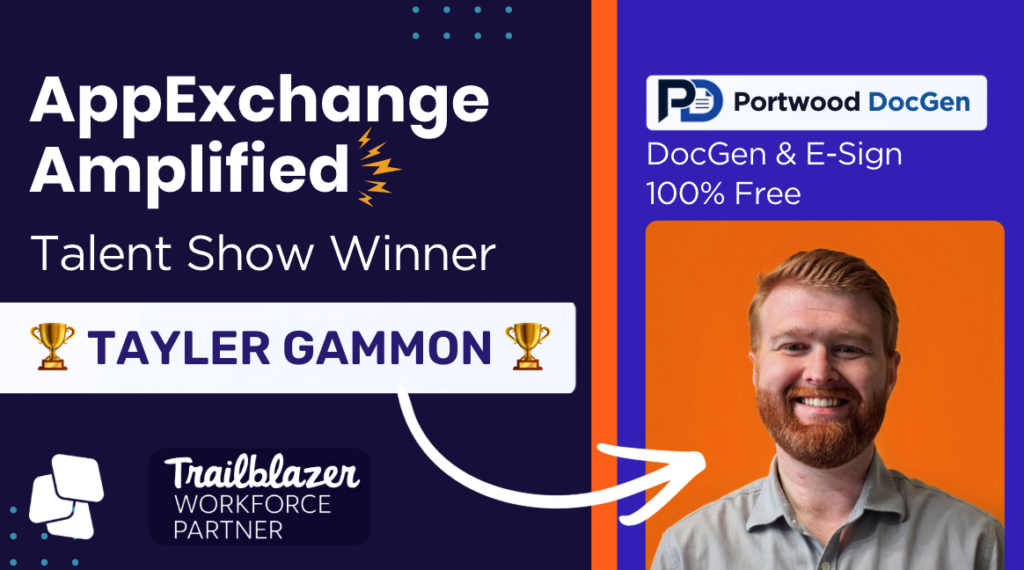
Bradley and Dave walk through the AppExchange Amplified build-along event facilitated by Talent Stacker. Approximately 300 people signed up, 60 attended live, and the event drove a surge of installs that pushed Portwood to number 12 globally on the Agent Exchange. The result:
- 60 attendees became unpaid advocates sharing Portwood in their own networks and with their clients.
- A community-produced demo video from the event’s talent show winner provided third-party social proof.
- A wave of five-star reviews followed on the Agent Exchange, building credibility with future installers.
Notable Insights
Build traction before you get approved. Dave had paying customers and hundreds of installs before Portwood was even listed on the Agent Exchange. Getting approved amplified existing momentum rather than creating it from scratch.
A free app can be a more powerful business asset than a paid one. By removing the price barrier entirely, Dave created a lead funnel that now delivers 10 to 20 qualified business contacts per day, something no paid listing has matched in his space.
Stay in your zone and hire for the rest. Dave initially hired out sales and kept doing development himself. The business only accelerated when he flipped that: staying in the sales seat and bringing in a developer. No one can sell your product better than you can at the early stage.
Open source is a trust strategy, not just a technical one. Making Portwood’s code public on GitHub answers the question every potential enterprise customer asks: what happens if the vendor disappears? The answer, in Dave’s case, is that the customer can simply keep running it themselves.
Word of mouth from practitioners is worth more than paid advertising. Dave puts it simply: one admin advocate inside a company is more likely to drive a sale than $1,000,000 in ads. A consultant recommending Portwood across 15 clients a year is the most efficient distribution channel imaginable.
How to Take Action
Identify a recurring problem in your Salesforce work and start building in public. You do not need a finished product to start generating interest. Dave posted a rough, early version on Reddit and GitHub and got 25,000 impressions on his first post. Start sharing what you are building before it is ready, gather feedback, and let community response tell you whether the idea has legs.
Protect your intellectual property from the start. If you are building something on your own time that you intend to own, keep it clearly separate from your employer’s work, clients, and infrastructure. Do not use company resources, do not build it for a specific client engagement, and understand your employment contract before you start sharing progress with anyone at work.
Install Portwood in your dev org and experience the model firsthand. Whether you are a job seeker, an admin, or a consultant, install Portwood on the Agent Exchange for free and run through the AppExchange Amplified build-along content in the show notes at talentstacker.com/appexchange-amplified. You will get hands-on experience with a real tool, and you will see exactly how a free app can create genuine value for your clients or employer.
Want Even More Salesforce Career Content?
Watch Salesforce Career focused videos, listen to podcasts and check the menu items above for links to free content and courses.