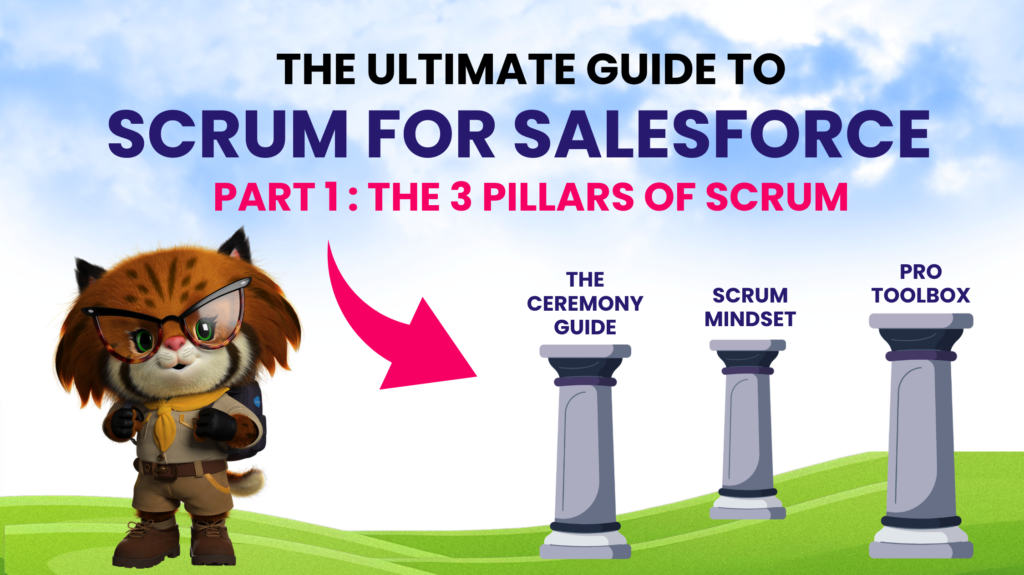
The Salesforce Scrum Series
The Scrum Glossary—Speaking the Language of Salesforce Delivery Success
Welcome to the second installment of our series. In our intro, we talked about moving from “chaos to confidence,” but you can’t have confidence if you feel like everyone in the room is speaking a different language.
If you’ve ever sat in a meeting and wondered why people are talking about “poker,” “spikes,” or “spillover,” this guide is for you. Mastering these 22 terms will ensure you’re never lost in translation during a sprint.
The Core Framework
- Scrum: An agile framework focused on iterative progress and continuous improvement. It’s the “engine” that powers your Salesforce delivery.
- Sprint: A time-boxed period (usually 2 weeks) where a specific set of work is completed.
- User Story: A feature description from the user’s perspective (e.g., “As a Sales Rep, I need to see a lead’s LinkedIn profile on the Account page so I can prepare for calls”).
- Task: The granular units of work required to actually build that User Story.
The People
- Scrum Master: The facilitator and “roadblock-remover.” They ensure the team stays true to Scrum principles.
- Product Owner: The guardian of the “What” and “Why.” They prioritize the backlog and ensure the team delivers value to stakeholders.
- The Developers: Refers to anyone committed to creating any aspect of a usable Increment each Sprint. This isn’t just limited to people writing code—it includes admins, architects, designers, researchers, or anyone doing the “work.”
The Lists (Backlogs)
- Product Backlog: The “Master List” of every feature, bug fix, and enhancement requested for your Salesforce instance.
- Sprint Backlog: The subset of items the team has committed to finishing during the current 2-week Sprint.
The Meetings (Ceremonies)
- Sprint Planning: The kickoff session where the team looks at their Capacity and decides what moves from the Product Backlog to the Sprint Backlog.
- Daily Stand-up: A 15-minute daily pulse check. Three questions: What did I do yesterday? What am I doing today? Are there any blockers?
- Sprint Review: The “Show and Tell” where you demo completed work to stakeholders and get feedback.
- Sprint Retrospective: The “How did we do?” meeting held at the end of a sprint to identify process improvements.
- Backlog Grooming: The process of refining, prioritizing, and estimating the effort of backlog items.
- Backlog Refinement: Another term for backlog grooming; many teams use these interchangeably to keep the backlog “ready.”
Measurement & Estimation
- Story Points: A unit used to estimate the effort, complexity, or size of a task/user story. It’s not about hours; it’s about the “weight” of the work. Some scrum teams estimate effort in T-Shirt sizing (small, medium, large, x-large), some use a modified fibonacci sequence like 1, 2, 3, 5, 8, 13, 20, 40, 100. The goal of story points is to measure effort, complexity, and uncertainty, not hours. As tasks get larger, our ability to estimate them accurately drops.
- Poker (Planning Poker): A consensus-based card game used by the team to assign Points to stories fairly.
- Capacity: How much work your team can actually do in a sprint, accounting for availability and skillsets.
- Velocity: A metric measuring the amount of work (usually in points) a team can complete within a sprint.
- Commitment Ratio: The percentage of work a team completes compared to what they originally committed to.
The Technical “Nitty-Gritty”
- Bug: An error or flaw in the software that affects functionality or performance.
- Spike: A research or investigation task used to gain knowledge needed for future work (common when exploring new Salesforce features).
- Spillover: Tasks or user stories not completed within a sprint that are carried over to the next one.

Pro-Tip for Salesforce Professionals
In the Salesforce world, we often deal with Spikes when exploring new AppExchange packages or Spillover when a complex deployment takes longer than expected. Using this vocabulary helps you explain why things are moving the way they are to your stakeholders with professional clarity.
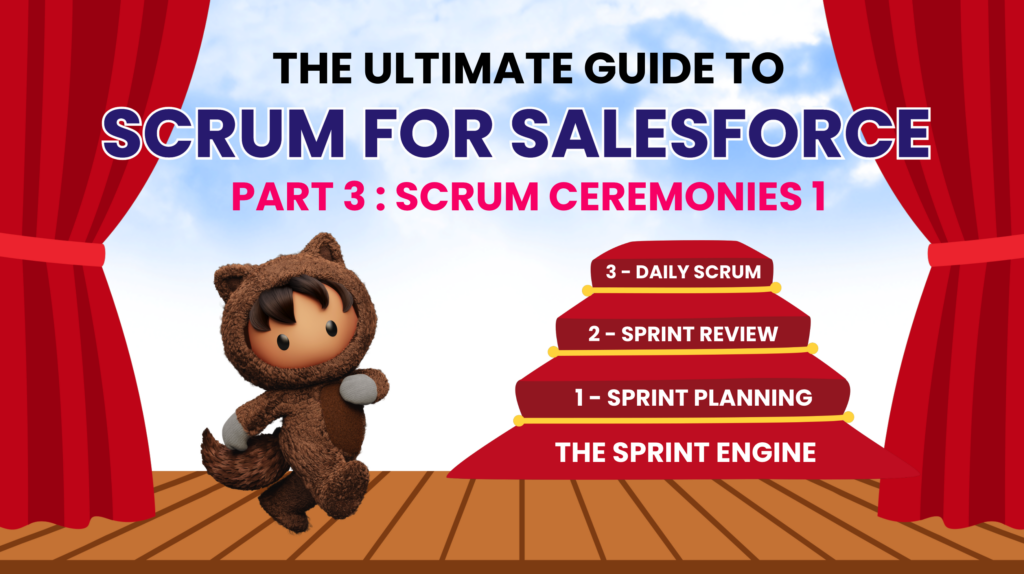
Now that we have the language down, are you ready to see these terms in action? In Article 3, we’ll dive into the first half of the Scrum Ceremony Guide: Sprint Planning, the Daily Stand-up, and the Review.
Want Even More Salesforce Career Content?
Watch Salesforce Career focused videos, listen to podcasts and check the menu items above for links to free content and courses.